Why temperature matters more than most buyers realise#
Falling asleep is not just about feeling tired, it is a thermoregulatory event. To initiate and maintain sleep, your body lowers its core temperature by roughly 1°C, shedding heat through the skin of your hands, feet and face. A mattress that traps that heat against your body works directly against this process, which is why "sleeping hot" so often shows up as restless nights, early waking and that clammy 3 a.m. feeling. In the UK, where most homes lack air conditioning, this becomes acute during summer heatwaves but affects warm sleepers, menopausal women and duvet-sharing couples all year round.
The sleep surface itself has a measurable effect. In a controlled study of six common mattress cushion materials, researchers found that the choice of material significantly changed the temperature recorded at the body–mattress interface, and that heat concentrated most at the back, buttocks and thighs, the points where your body sinks in and airflow is cut off.1 In other words, where you make the most contact is exactly where heat builds up, so a cooling mattress is really about managing those contact zones.
Our top cooling picks at a glance#
Every pick is independently scored on our 10-point framework (see how we score). We may earn a commission on links, at no extra cost to you; it never affects a score.
| Mattress | Best for | Cooling approach | Price (double) | Our score |
|---|---|---|---|---|
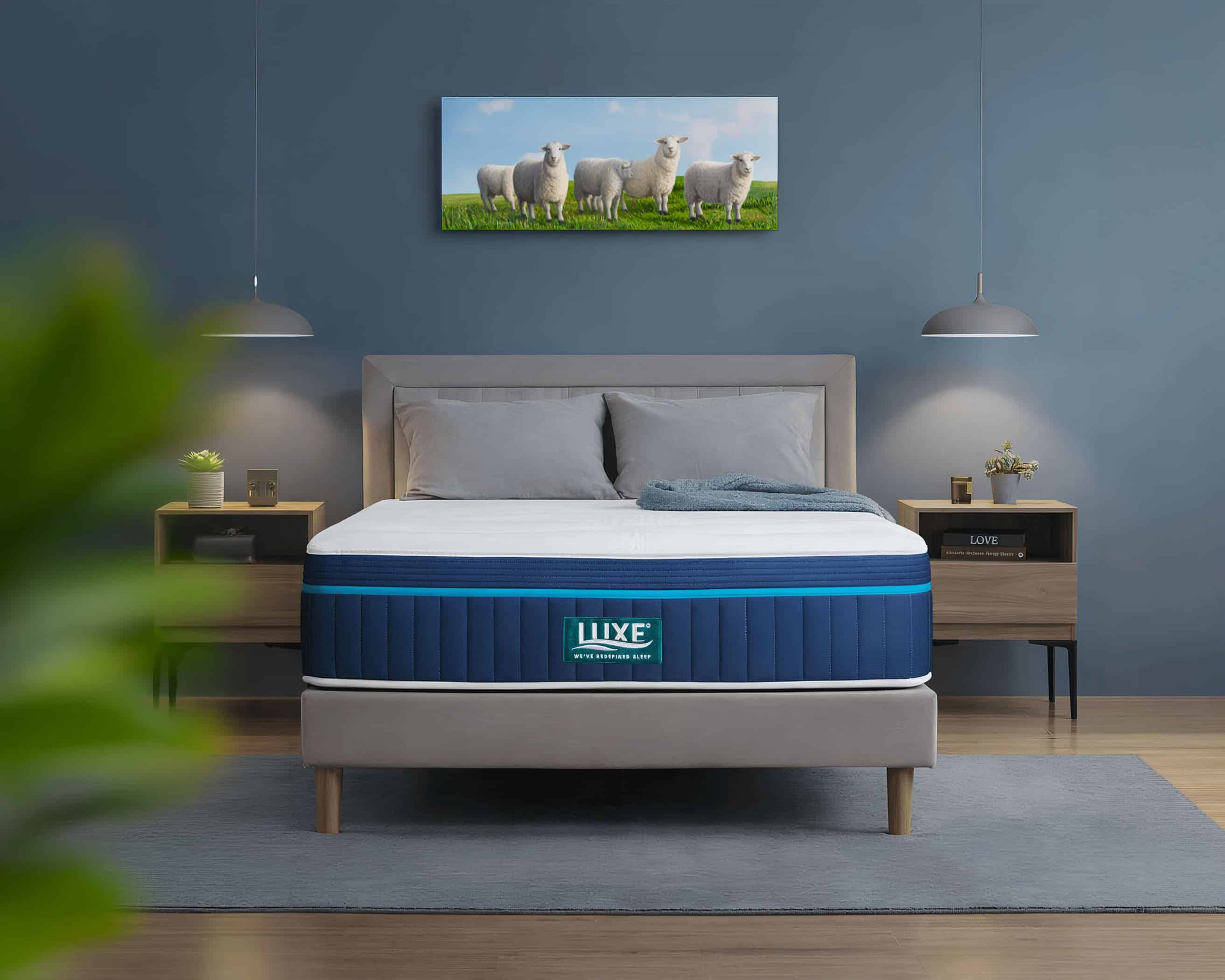
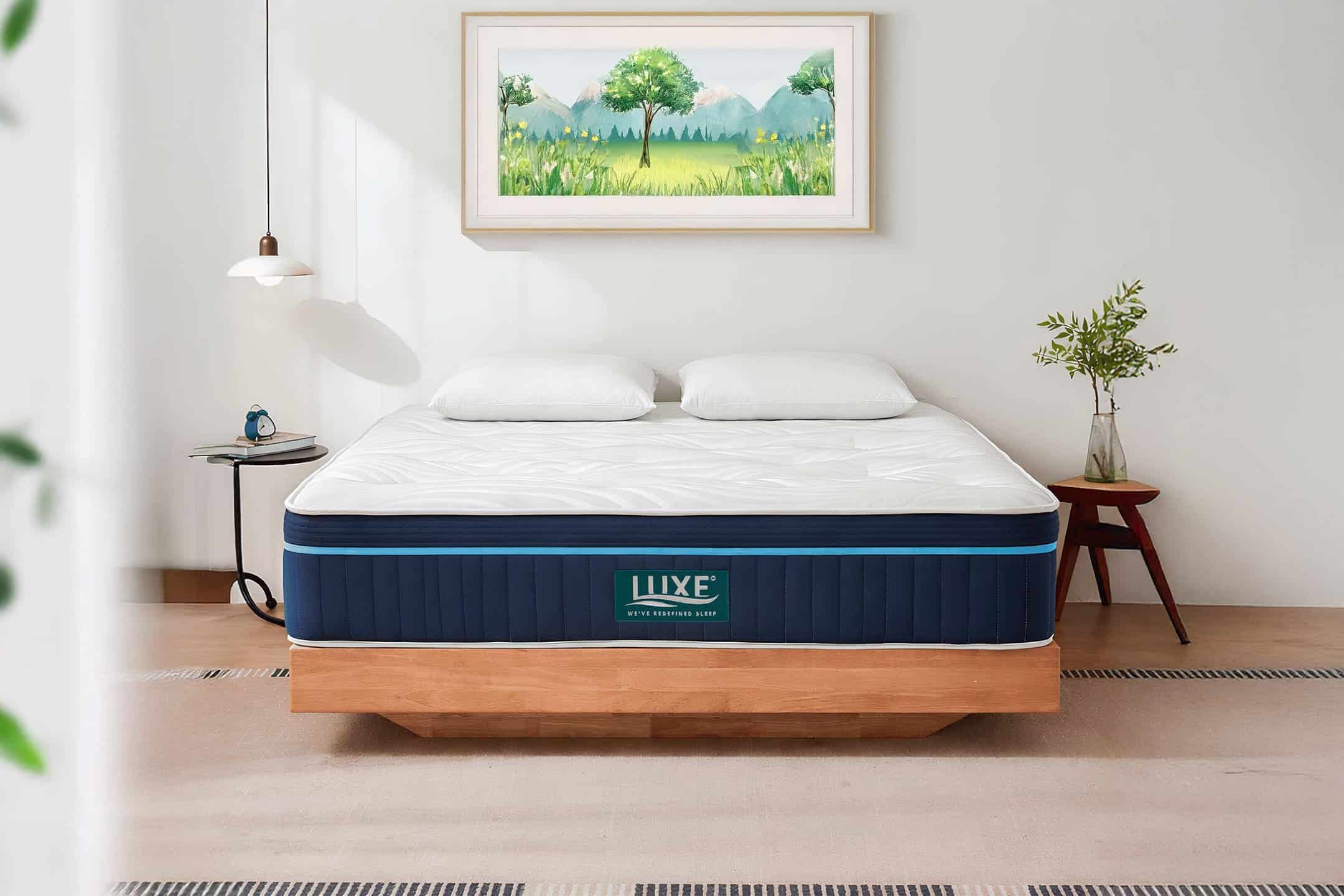
| LuxeTherm Hybrid | Best overall cooling value | Spring airflow + temperature-regulating layer | £337 | 8.3 |
| Core CoolMax Memory Foam | Best budget cooling | CoolMax moisture-wicking cover | £147 | 8.4 |
| Comfort CoolMax Intelligent | Best cooling foam under £200 | CoolMax cover + intelligent foam | £192 | 8.5 |
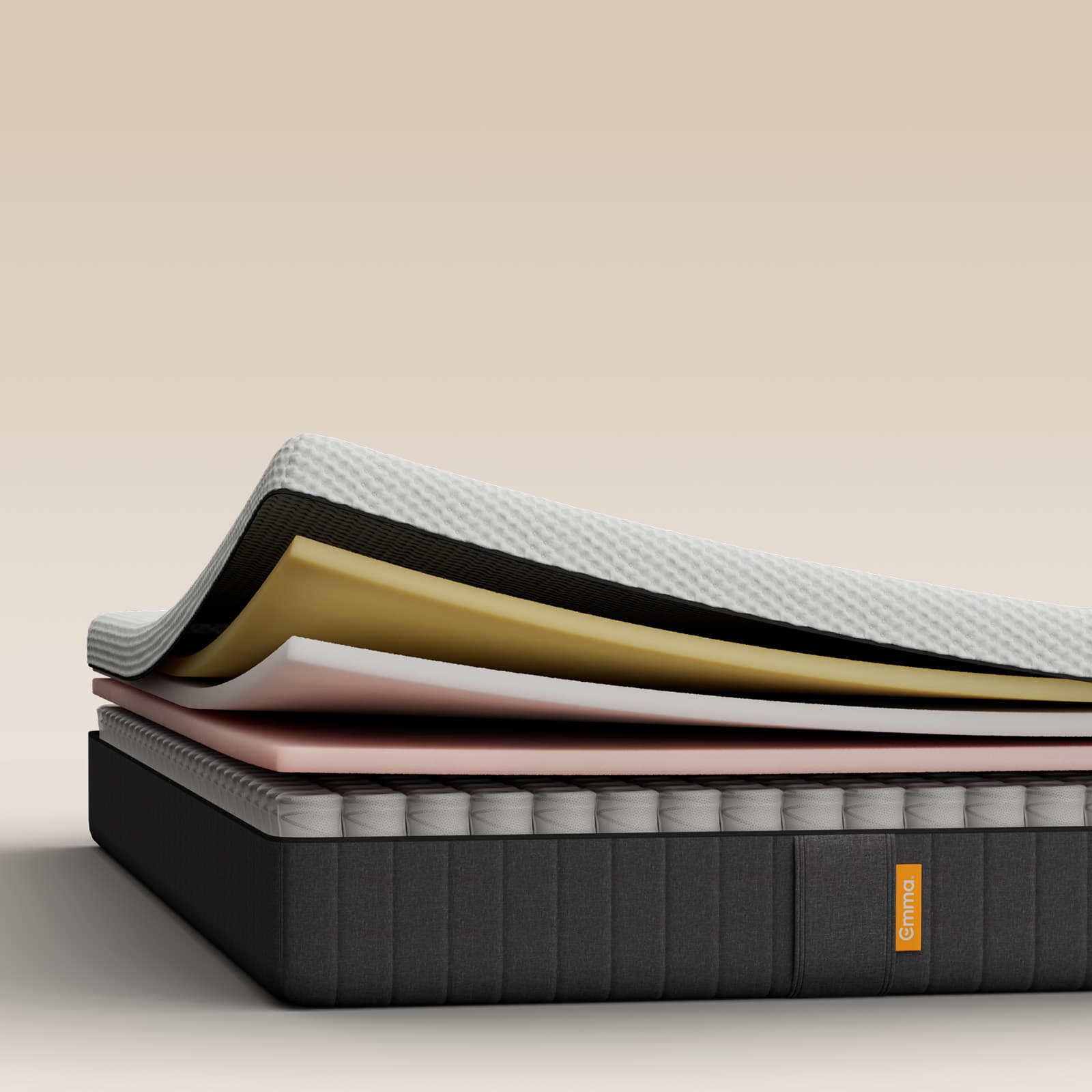
| Emma Original Elite | Best premium all-rounder | Graphite-infused foam + cooling cover + springs | £999 | 8.8 |
| Emma Luxe Cooling | Best no-compromise cooling | Phase-change cover + tall spring core | £1,099 | 8.6 |
| Tencel 1000 | Best natural-fibre option | Tencel cover + open spring core | £339 | 8.2 |
Best overall cooling value: LuxeTherm Hybrid#
The LuxeTherm Hybrid attacks heat from both directions: an open pocket-spring core that keeps air moving underneath you, and a temperature-regulating comfort layer that stays closer to skin temperature than standard memory foam. At £337 for a 28cm hand-built hybrid it's the pick we recommend to most hot sleepers.
Best budget cooling: Core CoolMax Memory Foam#
At £147, the Core CoolMax wraps its foam core in the same moisture-wicking CoolMax fabric used in sportswear, wicking sweat away before it turns clammy. An all-foam build can't match spring airflow, but for the price it's a big upgrade over standard foam covers.
Best cooling foam under £200: Comfort CoolMax Intelligent#
The Comfort CoolMax Intelligent steps up to a 20cm build whose "intelligent" foam responds to body temperature, softening where you're warm for better pressure distribution, under the same wicking CoolMax cover. £192, and our highest-scoring dedicated cooling foam (8.5).
Best premium all-rounder: Emma Original Elite#
Not marketed primarily as a cooling mattress, but the Original Elite's graphite-infused foam conducts heat away (graphite is one of the few additives with real thermal effect), on top of a tall spring unit and under a cooling cover. If you want the best mattress that also runs cool, rather than a cooling mattress, this is it.
Best no-compromise cooling: Emma Luxe Cooling#
The Emma Luxe Cooling is Emma's flagship answer to hot sleeping: a phase-change cover that absorbs heat as you fall asleep, over 30cm of springs and breathable foams. It scored 9.2 for support, the second-highest on the site. At £1,099 it's for people whose overheating is severe enough to price a solution like air conditioning.
Best natural-fibre option: Tencel 1000#
The Tencel 1000 takes the natural route: a Tencel (wood-fibre) cover that wicks moisture better than cotton, over 1,000 pocket springs with no thick foam slab at all. Its soft feel also makes it a candidate in our side sleeper guide.
What actually makes a mattress sleep cool#
Marketing language ("ice", "arctic", "chill") rarely tells you what is doing the work. There are only a handful of mechanisms that genuinely move heat away from your body:
- Airflow and open structure: Heat is carried away by moving air. Pocket-spring and hybrid mattresses have an open coil layer that lets air circulate; dense foam blocks do not. This is the single biggest factor.
- Breathable cover fabrics: Natural fibres such as wool, cotton, Tencel and bamboo-derived viscose wick moisture and breathe far better than tightly knitted polyester. Wool in particular regulates temperature in both directions.1
- Open-cell and convoluted foams: Traditional memory foam is dense and heat-retaining. Open-cell foam, "air-flow" cut channels and latex (which is naturally more breathable) reduce that trapping effect.
- Gel and phase-change materials (PCM): Gel pods and PCM layers absorb and redistribute heat. Their effect is real but modest and front-loaded, they help you fall asleep cooler rather than keeping you cool for eight hours.
- Avoiding excessive sinkage: The deeper you sink, the more your body is "hugged" and the less air reaches your skin. A supportive, medium-firm feel keeps you nearer the surface where air can move.
Which mattress type sleeps coolest?#
Ranked roughly from coolest to warmest for the average UK sleeper:
| Type | Cooling performance | Why |
|---|---|---|
| Pocket sprung | Excellent | Open coil layer maximises airflow; minimal heat-trapping foam |
| Hybrid | Very good | Spring core airflow plus a thinner comfort layer; the best all-round balance |
| Latex | Good | Naturally breathable with a pinhole structure, though dense and heavier |
| Gel memory foam | Moderate | Gel offsets some heat retention but the foam base still insulates |
| Traditional memory foam | Warmest | Dense, closed-cell structure contours closely and traps body heat |
For most hot sleepers, a hybrid mattress is the sweet spot: you get the airflow of springs without giving up pressure relief. Pure memory foam can still work if it uses open-cell foam, a breathable cover and a sprung or slatted base underneath, but it will always be the riskier choice if overheating is your main complaint.
Does firmness affect how hot you sleep?#
Indirectly, yes. Softer mattresses let you sink deeper, increasing the contact area that traps heat. A medium-firm surface keeps more of your body nearer the surface where air can circulate. Helpfully, medium-firm also tends to be the best-supported choice for sleep quality overall: a polysomnography study found medium firmness produced shorter sleep latency and more stable sleep architecture than a soft mattress, which caused more stage transitions and restlessness.2 So choosing medium-firm often improves airflow and support at the same time.
Your cooling-mattress checklist#
- Sprung or hybrid core if overheating is your primary problem.
- Natural or moisture-wicking cover (wool, cotton, Tencel, CoolMax) rather than dense polyester.
- Open-cell or gel-infused comfort foam, never a thick slab of standard memory foam.
- Medium to medium-firm feel to limit heat-trapping sinkage.
- A breathable base: sprung slats or a ventilated divan beat a solid platform that blocks underside airflow.
- A long trial period (most UK brands offer 100–365 nights) so you can test through a warm spell before committing.
Pair the right mattress with breathable cotton or linen bedding and a lower-tog summer duvet, the bedding system as a whole drives your overnight temperature, not the mattress alone.2
Beating a UK heatwave: beyond the mattress#
- Ventilate early and late: open windows before 9 a.m. and after sunset; keep blinds down through the afternoon.
- Swap the duvet, not just the mattress: a 4.5-tog summer duvet or a flat cotton sheet makes a bigger single-night difference than any foam additive.
- Cotton or linen bedding only: polyester sheets undo a breathable mattress cover.
- Cool the body, not the room: a lukewarm shower an hour before bed helps your core temperature drop on schedule.
- Check the base: a solid platform under a breathable mattress blocks half its airflow; sprung slats fix it cheaply.
What about durability and off-gassing?#
Two common worries. First, longevity: a mechanical durability study found both polyurethane-foam and pocket-spring mattresses largely held their firmness and support over simulated long-term use, with the spring sample showing only slight softening, so a quality breathable mattress should keep performing for years.3 Second, the "new mattress smell": foam off-gassing is the release of volatile organic compounds, and an indoor-air study of new memory-foam mattresses measured concentrations well below health-based benchmarks, with emissions decaying over the first few weeks.4 Air a new mattress for a day or two and any odour fades quickly.
Frequently asked questions#
What is the best cooling mattress in the UK?#
For most hot sleepers, the LuxeTherm Hybrid at £337: real spring airflow plus a temperature-regulating layer. With a bigger budget, the Emma Luxe Cooling is the most complete solution we've scored.
Are cooling mattresses worth it?#
If you regularly wake up hot or sweaty, yes, but the value comes from genuine airflow and breathable materials, not from "cooling" branding. A standard hybrid will out-perform a memory-foam mattress with a gel gimmick layer.
Do gel memory foam mattresses really stay cool all night?#
Gel helps you fall asleep cooler by absorbing initial body heat, but once saturated it stops drawing heat away. For all-night cooling, airflow from a sprung or hybrid core matters more.
What is the coolest mattress material?#
For airflow, pocket springs. For surface feel, a natural-fibre cover such as wool or Tencel. The best cooling mattresses combine both.
Is there a cooling mattress under £150?#
Yes, the Core CoolMax Memory Foam at £147 uses a genuine CoolMax wicking cover. Manage expectations: at this price the cover works hard but the foam core still insulates more than springs would.
Do cooling mattress toppers work instead?#
A breathable topper (wool, latex) can take the edge off a hot mattress for less money, but it cannot add airflow to a dense foam core underneath. If your mattress is due for replacement anyway, fix the core problem.
Ready to choose? Compare breathability, firmness and live prices across our full mattress range, take our 60-second quiz for a personalised match.
We may earn a commission if you buy through our links, at no extra cost to you. See our affiliate disclosure.
References#
- Li X, Zhou B, Wu Z, et al. Exploring the effect of mattress cushion materials on human–mattress interface temperatures, pre-sleep thermal state and sleep quality. Indoor and Built Environment. 2021;30(5):650–667. doi:10.1177/1420326X20903375
- Hu X, Gao Y, Song Y, et al. The Effect of Mattress Firmness on Sleep Architecture and PSG Characteristics. Nature and Science of Sleep. 2025;17:865–878. doi:10.2147/NSS.S503222
- Vlaović Z, Klarić N, Domljan D. Investigating the Impact of Long-Term Use on Mattress Firmness and Sleep Quality: Preliminary Results. Applied Sciences. 2024;14(21):10016. doi:10.3390/app142110016
- Beckett EM, Miller E, Russman E, Pierce JS, Unice K. Evaluation of volatile organic compound (VOC) emissions from memory foam mattresses and potential implications for consumer health risk. Chemosphere. 2022;303:134945. doi:10.1016/j.chemosphere.2022.134945